Sliding materials for reliable food and beverage processes
Whether seal ring, slide bearing or vane: Schunk develops tailored material and component solutions for tribological applications. Benefit from low friction, low wear, high media resistance and application-specific consulting for your food and beverage application.
Compliance First, Performance Next: FDA-Compliant Materials for Food & Beverage
Schunk offers FDA-compliant materials that meet the requirements of EC 1935/2004 — with WRAS, KTW-UBA, California Prop 65 compliance, or PFAS-free options available depending on the application. For pumps, seals, and bearings that need to perform reliably.
AI-Generated
When selecting materials for food and beverage applications, one question often comes first: Does the material meet the required compliance standards?
If it does not, high strength, low friction, or excellent media resistance are beside the point. In many applications, regulatory compliance determines which food-grade materials can even be considered.
Our materials are FDA compliant and meet the requirements of EC 1935/2004. Depending on the application, materials with WRAS, KTW-UBA, or California Prop 65compliance are also available, along with PFAS-free solutions.
Once that requirement is met, the technical selection begins. A compliant material still has to perform reliably in the actual process.
Compliance Narrows the Field — the Application Determines the Material
Pumps, seals, and bearings in the food and beverage industry often operate in direct contact with process media. Their components are exposed to friction and wear while also needing to resist chemical attack, maintain dimensional stability, and perform within tight manufacturing tolerances.
Lubrication is another important factor. We offer materials for lubricant-free and dry-running operation, as well as media-lubricated solutions. In suitable applications, this can help eliminate additional lubricants and reduce potential sources of contamination.
This creates a clear engineering profile for material selection: What process medium is involved? What mechanical and thermal loads will occur? How critical are friction, wear, and dimensional stability? Which tolerances must be maintained?
Compliance is the first filter. After that, the material has to prove itself under real operating conditions.
Graphite or Silicon Carbide? The Material Name Alone Is Not Enough
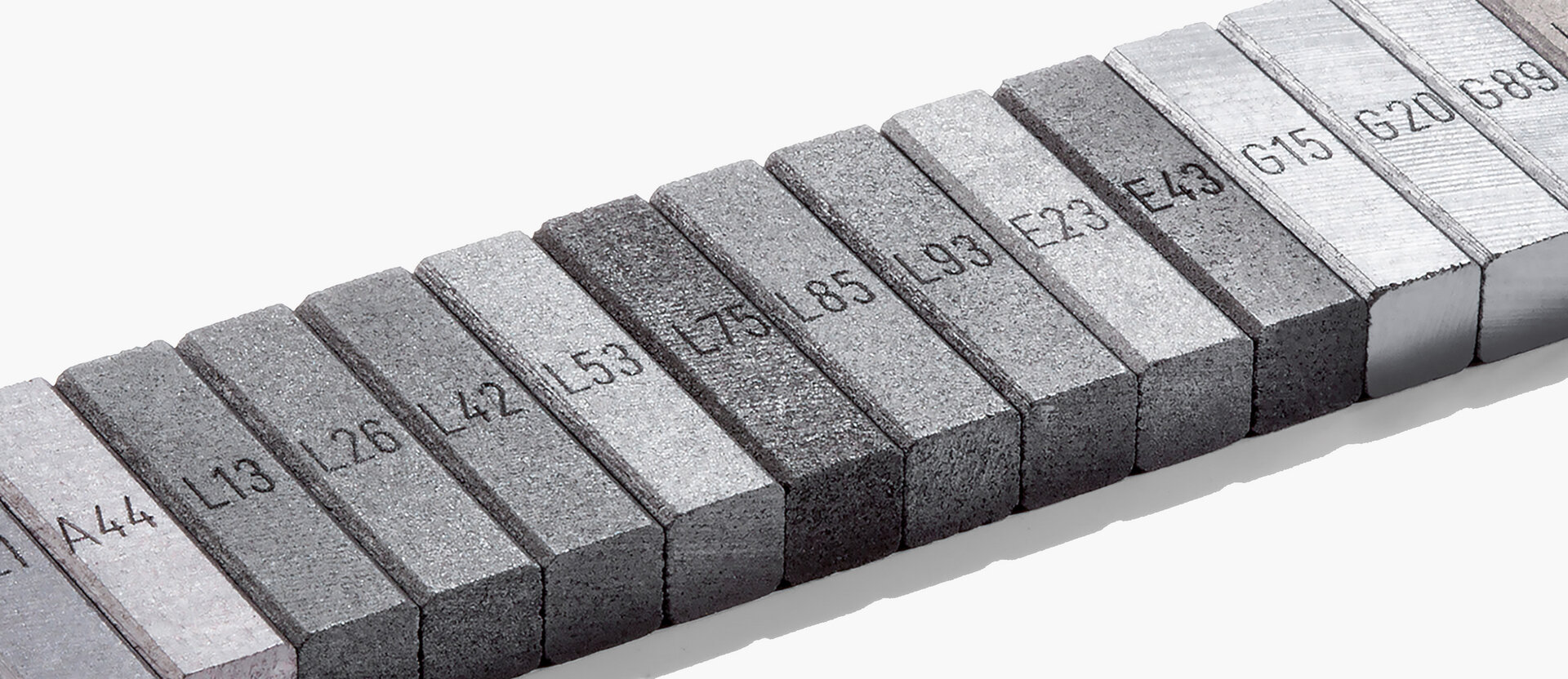
The differences are already clear within the graphite family. For the listed carbon graphite grades, typical flexural strength ranges from 60 to 75 MPa. The electrographite grades shown are listed at 45 and 55 MPa.
Their thermal properties also vary significantly. The carbon graphite grades shown have typical thermal conductivity values of 6 to 11 W/mK, while one electrographite grade is listed at 65 W/mK.
Silicon carbide offers a different property profile. The SSiC grade considered here has a typical flexural strength of 390 MPa and a Young’s modulus of 400 GPa. For the corresponding SiSiC grade, the values are 280 MPa and 360 GPa, respectively. Thermal conductivity is 110 W/mK for SSiC and 120 W/mK for SiSiC.
For engineers, that means the choice is not simply between “graphite” and “silicon carbide.” The specific grade determines whether the material matches the component’s actual load profile.
The values listed are typical, non-binding values. Material and manufacturing variations must be taken into account during engineering design.
Three Components — and Three Different Sets of Requirements
The differences become especially clear when looking at three typical components: rotary vanes, plain bearings, and axial seal rings.
For arotary vane, friction and wear directly affect function and service life. Dry-running or lubricant-free materials can offer advantages when the application calls for them.
A plain bearing has a different set of demands. Low friction, low wear, media resistance, and dimensional stability all have to work together. Where tight tolerances are involved, precise machinability is equally important.
With anaxial seal ring, the material, mating surface, and process medium interact directly. Its suitability cannot be judged from a single material property. The tribological system has to be considered as a whole.
That is why there is no single food and beverage material that fits every component. A material that performs well in one application may not be the right choice for another.
Build Food and Drinking Water Compliance Into the Specification Early
Because technical and regulatory requirements are closely linked, compliance should be addressed early in the development process.
In addition to FDA compliance and EC 1935/2004, other requirements may apply depending on the application. For those cases, Schunk also offers materials with WRAS or KTW-UBA compliance, California Prop 65 compliance, and PFAS-free material solutions.
For customers, this has a practical benefit: material selection can focus from the outset on options that meet both the required compliance standards and the technical performance profile.
We support this process with application engineering expertise and comprehensive documentation, so regulatory requirements, process media, and component function can be evaluated together.
From Specification to Reliable Component Performance
A datasheet is an important reference, but it does not capture the full application. For reliable long-term operation, the material, component design, and manufacturing process all have to work together.
Our products are made from raw materials that undergo defined treatments or are selected according to precise specifications. The manufacturing processes also follow clearly defined technical requirements. For specialized applications, additional materials are available beyond the standard selection.
This allows us to match material selection to the actual task rather than applying one standard grade across very different operating conditions.
What Matters in the Process
For operators, the material designation on the drawing is not what matters most. What matters is how reliably the component performs, how often it needs maintenance, and how stable the production process remains.
With our material solutions, customers benefit from stable processes, reduced maintenance intervals, higher operational reliability, and more cost-effective production processes.
Several material properties contribute to those results. Low wear can support longer service life. A low coefficient of friction can improve operating efficiency. Chemical resistance and dimensional stability help the component maintain its function under the intended conditions. Lubricant-free or media-lubricated designs can also help keep additional substances out of the process.
The benefit comes from the right combination: compliance, material, and application all have to fit together.
Conclusion: Compliance Is the Starting Point, Not the End of Material Selection
For many food and beverage applications, required compliance determines which materials are even eligible. After that, the material still has to perform in the process.
With FDA-compliant materials that meet EC 1935/2004, additional application-specific compliance options, PFAS-free solutions, and a range of grades in carbon graphite, electrographite, SSiC, and SiSiC, we address both sides of material selection.
That means the search does not end with a material that has the right documentation. It leads to a material solution that fits the component, process medium, and operating conditions — and supports reliable process performance.
Interested in more information?
Discover relevant brochures and technical information on FDA-compliant materials for food and beverage applications.
Learn more about sliding materials for pumps, compressors and seals – and how Schunk Carbon Technology designs carbon and silicon carbide materials for tribologically stressed components.
Sliding materials for reliable food and beverage processes
Whether seal ring, slide bearing or vane: Schunk develops tailored material and component solutions for tribological applications. Benefit from low friction, low wear, high media resistance and application-specific consulting for your food and beverage application.