ALUMINIUM GRAPHITE AS A MATERIAL

Aluminium graphite – lighter than metal, stronger than graphite

Aluminium graphite (ALG) is a metal matrix composite (MMC) that combines the thermal properties of graphite with the machinability and robustness of aluminium. The result is a material that, in power electronics, micro- and optoelectronics, and back-end processing, is superior to conventional alternatives such as copper, CuW or CuMo in all key respects: faster heat transfer, better CTE matching, and significantly lower weight. 

When is aluminium graphite the right choice?

Aluminium graphite is the right choice when at least two of the requirements listed below must be met simultaneously – requirements which conventional materials can meet individually, but not all at once: 

Heat must be dissipated quickly and evenly 

Aluminium graphite conducts heat faster than aluminium and copper – as a comparative heating curve shows, ALG reaches operating temperature sooner and distributes it more evenly across the component’s surface. 

The material must exhibit thermal behaviour similar to that of semiconductor materials and ceramic substrates 

The CTE of aluminium graphite is well matched to that of the materials commonly used in electronic assemblies. Copper, on the other hand, expands significantly more – and, with every temperature change, generates stresses at the joints, which lead to delamination in the long term. 

The component must be as light as possible 

The clearest advantage lies in density: aluminium graphite weighs less than 2.5 g/cm³ – copper weighs almost 9 g/cm³ and CuW as much as 15.6 g/cm³. This is a strategic advantage for all weight-critical applications. 

Baseplates, interposers and heat sinks – dissipating heat from the semiconductor

Aluminium graphite is used wherever heat needs to be dissipated from a semiconductor as quickly and reliably as possible – and where, at the same time, the thermal expansion behaviour of the substrate contributes to the service life of the entire assembly. Schunk Carbon Technology has deliberately focused on microelectronics and optoelectronics: power amplifiers, converters, lasers and high-frequency applications, where the technical requirements are considerably more stringent. Other target sectors include aerospace and telecommunications. 

Baseplates

Aluminium graphite baseplates form the thermal interface between the cooling structure and the semiconductor. As the semiconductor is not usually mounted directly onto the baseplate but via a ceramic or an interposer, the CTE match is less critical here than in the case of direct semiconductor mounting. The key factors are high thermal conductivity for rapid heat dissipation, as well as mechanical stability and flatness over many temperature cycles. ALG2208 is the preferred grade here – with up to 220 W/m·K in the x/y direction, it offers the fastest heat transfer and retains its flatness even after many soldering and sintering cycles. 

Interposer

In the case of interposers, the semiconductor is mounted directly onto the Aluminium graphite component – without any ceramic buffer in between. Here, the CTE match with the semiconductor material is critical: any difference in thermal expansion generates mechanical stresses at the joint during every load cycle, which accumulate to cause thermal fatigue. Aluminium graphite, with its CTE tailored to semiconductor materials, minimises these stresses and has been proven to extend the service life of the joint – particularly relevant in aerospace and high-frequency applications, where component failure is not an option. 

Heatsinks

Aluminium graphite heat sinks combine high thermal conductivity with low weight and a CTE that is precisely matched to the mounted component. As with interposers, the semiconductor is mounted directly onto the heat sink – CTE matching is therefore equally critical. Particularly in mobile applications such as aerospace, telecommunications and portable high-performance systems, the low density of less than 2.5 g/cm³ plays a crucial role: Aluminium graphite heat sinks offer thermal performance that surpasses that of copper – at a fraction of the weight. 

What are the benefits for you?


Longer module service life 

In a comparative study of thermal shock behaviour (-40 °C to +125 °C), aluminium-graphite base plates showed no signs of delamination even after 2,000 cycles. Copper base plates failed after just 1,000 cycles. For the customer, this means lower failure rates, fewer warranty claims and greater confidence in their own products. 

Higher production throughput 

When used as a brazing fixture, aluminium graphite conducts heat more quickly and evenly than aluminium or steel – this shortens process times and increases throughput. Aluminium graphite jigs are mechanically more robust than graphite and can withstand significantly more brazing and sintering cycles – which reduces the total cost of ownership. 

Weight reduction without compromising performance 

Wherever copper is used, aluminium graphite can significantly reduce weight whilst delivering comparable or better thermal performance. This is just as relevant in the power electronics of electric vehicles as it is in the aerospace sector or in portable systems. 

Security of supply 

Schunk Carbon Technology controls the entire supply chain – from raw materials to the finished component. Customers receive not just a material, but a partner who ensures quality at every stage of the process. 

ALUMINIUM GRAPHITE

An overview of material grades

Aluminium graphite is available in various grades, which are selected according to requirements for CTE, thermal conductivity and mechanical properties. ALG1808 and ALG2007 are particularly suitable for use as jigs for the positioning and alignment of components – they offer higher mechanical strength and wear resistance. ALG2208 is the preferred grade for baseplates and thermal substrates.

undefined

Workability and processing

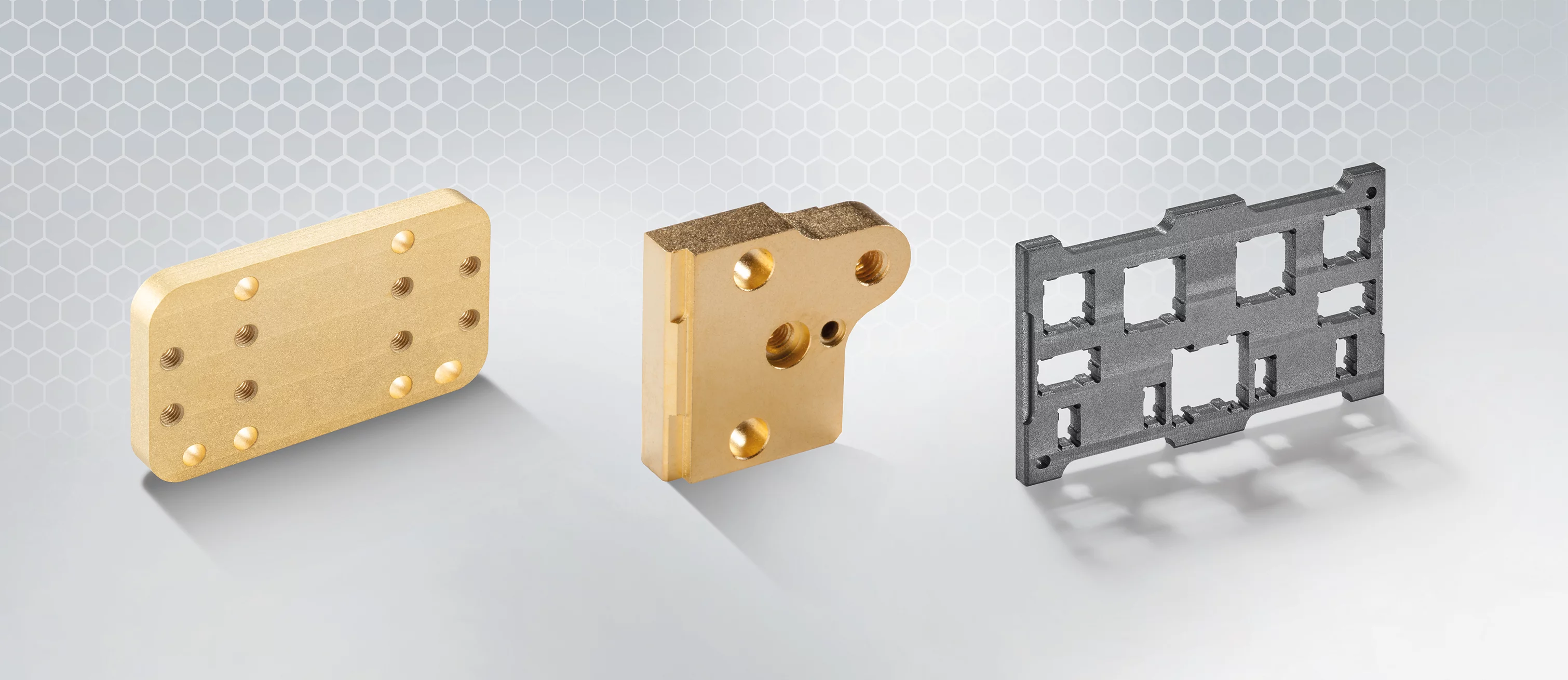
Aluminium graphite can be machined without the need for expensive specialist tools. Complex geometries featuring thin webs, radii, chamfers, bores, bases and cavities can be produced to tight dimensional tolerances. 

Hybrid solutions combining aluminium graphite with metal components are possible – for example, when joining components with different thermal expansion properties or when additional pressure is required during the joining process. Data Matrix codes for full traceability can be applied. 

The benefits of Schunk’s aluminium graphite

  • Significantly lighter than copper (2.1–2.3 g/cm³ vs. 8.9 g/cm³) – with comparable or higher thermal conductivity 
  • CTE well-matched to semiconductor materials and ceramic substrates 
  • Proven: no delamination after 2,000 thermal shock cycles; copper fails after 1,000 
  • Used as baseplates, interposers and heat sinks – with CTE matched directly to the mounted component 
  • Faster heat transfer than conventional materials – higher production throughput 
  • Three material grades for isotropic and anisotropic applications, depending on requirements 
  • Machinable to tight tolerances, even with complex geometries 
  • Hybrid solutions with metal components possible 
  • Design engineering service and full supply chain control provided by Schunk 
Any questions?

Let us advise you

Do you have any questions about aluminium graphite? We’ll show you how you can make the most of the benefits of ALG! 

Get in touch
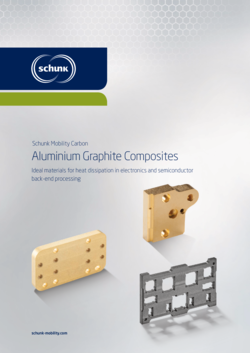
Brochure: Aluminium Graphite Composites

Ideal materials for heat dissipation in electronics and semiconductor
back-end processing

Add
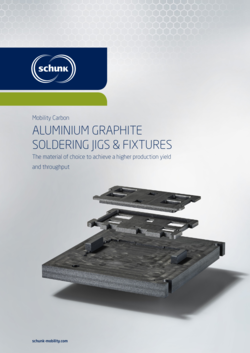
Brochure: Aluminium Graphite Composites

Aluminum Graphite Soldering Jigs & Fixtures: The material of choice to achieve a higher production yield
and throughput

Add
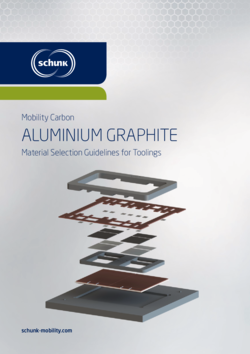
Brochure: Material Selection Guide

Material selection guide for toolings: aluminium graphite

Add

Downloads

3 Files online

Aluminum graphite has a wide range of applications—see for yourself

Home