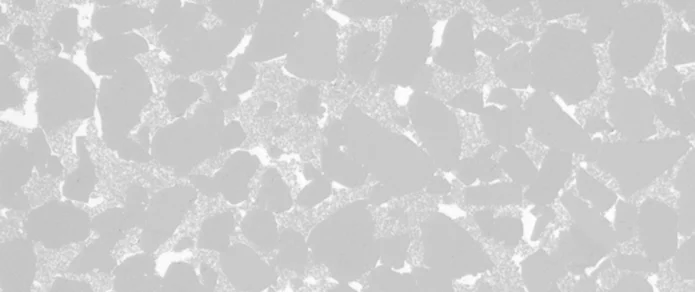
Reaction-bonded silicon carbide
High flexural strength with consistent hardness and lightness
Whether in the petrochemical industry, chemical engineering, pump construction or shipbuilding, sliding rings, sliding bearings, pump impellers and other tribological components used in aggressive environments are permanently exposed to high stress What is needed here are materials that are resistant to external influences and function reliably. This is the perfect environment for our silicon carbide ceramics. As one of the lightest and at the same time hardest ceramic materials, silicon carbide shows its advantages wherever high corrosion and wear resistance is required and materials of safety-relevant components must not fatigue prematurely.
Silicon carbide differs depending on the manufacturing method and is therefore suitable for various applications. Depending on your requirements, we use reaction-bonded SiC, sintered SiC and - for geometrically complex products - 3D-printed IntrinSiC® to manufacture your components. Here, you can rely on the materials expertise and advice of our experts at Schunk Technical Ceramics.
Silicon carbide (chemical formula: SiC) is a compound of silicon and carbon that is used in a wide range of high-performance applications due to its extreme hardness, heat resistance, and electrical properties. It is considered one of the most important technical ceramics.
Silicon carbide is distinguished by its exceptionally high hardness, very good thermal conductivity, electrical insulating capability, and chemical resistance. In addition, it is thermally stable at temperatures exceeding 1,600 °C and exhibits outstanding wear resistance.
Silicon carbide is used in semiconductor technology, the automotive industry, chemical process engineering, aerospace, as well as energy and environmental technologies. It is particularly well suited for extreme operating conditions, such as high-temperature or high-pressure environments.
Silicon carbide is most commonly produced using the Acheson process. In this method, silicon dioxide (quartz sand) and carbon react with each other at temperatures above 2,000 °C. The result is a crystalline material that is further processed depending on its purity level and grain size.
Reliable under the Toughest Conditions
Do you have any questions about our silicon carbide materials?