
Press conference on the annual results 2025
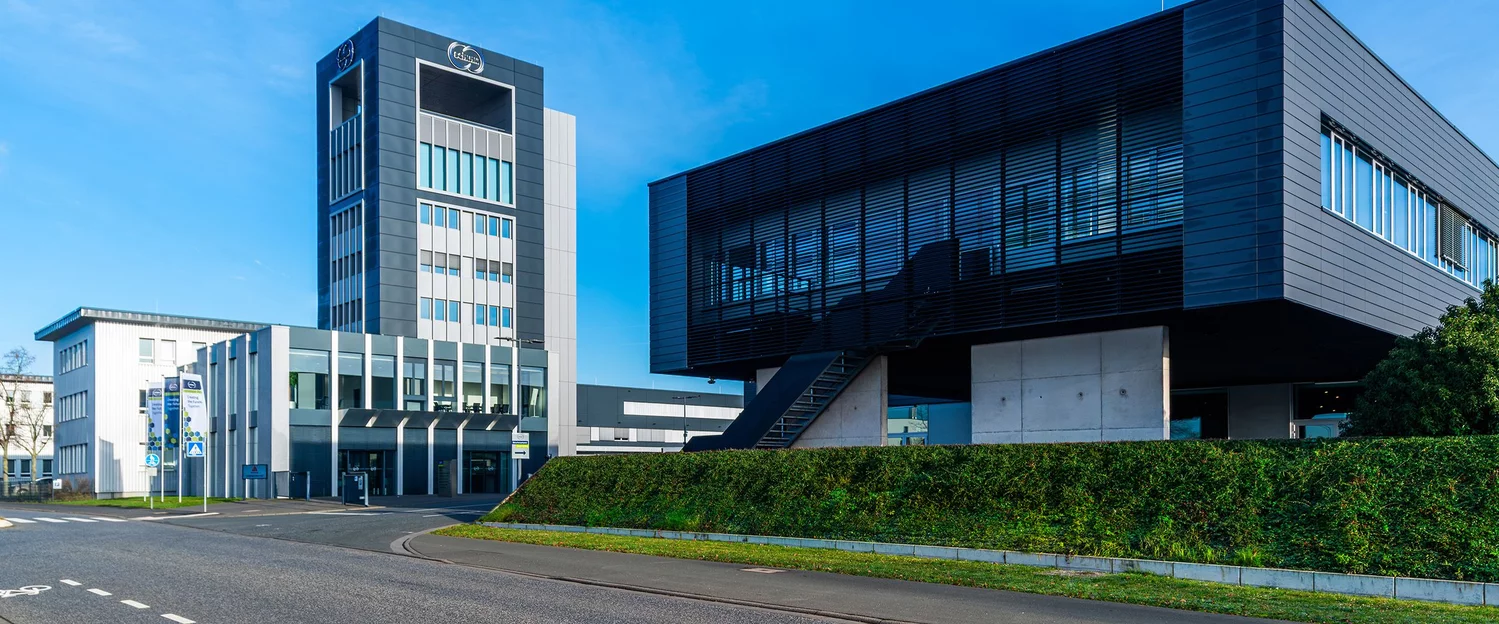
Heuchelheim, May 12, 2026 – At today’s annual press conference, Schunk Group reviewed a challenging fiscal year 2025 and outlined its strategic direction for the years ahead. The globally active technology group, headquartered in Heuchelheim, aims to achieve profitable growth in the aerospace as well as the security and defense industries, and is investing in production capacities in Germany and China. Initial positive effects are already visible at the start of 2026.
The year 2025 posed significant challenges for mid-sized industrial companies—including Schunk Group. The war in Ukraine, U.S. tariffs, inflation, and increasing competition from China placed considerable pressure on key industries and markets. “Last year clearly showed us that we must adapt to permanently changing conditions,” said CEO Peter R. Manolopoulos at the press conference at the Group’s headquarters in Heuchelheim. In some areas, business has declined permanently; in others, no short-term recovery is in sight. Schunk responded with a clear course of action: on the one hand, measures to increase cost efficiency and competitiveness; on the other, its Strategy 2030 to secure long-term growth.
The technology group’s revenue declined by 6 percent last year to € 1.7 billion. Profit also decreased. The slowdown in the automotive industry and declining demand in the semiconductor sector due to existing overcapacities were particularly noticeable. Both are key industries for the company, the CEO noted: “The European automotive market is unsettled—we see this in a significant reluctance to invest. At the same time, the transition to e-mobility continues, reducing demand for many Schunk products that have traditionally been used in internal combustion engines.”
In the semiconductor industry, artificial intelligence is acting as a growth driver, but only for part of the overall market: “These gains have been far from sufficient to offset declines in other areas such as power electronics. We must face the fact that Chinese manufacturers have established a strong position here.”
Staff adjustments and structural measures were therefore unavoidable at certain German locations—among others, in the course of transforming the sintered metal division in Heuchelheim, as well as at Weiss Technik sites in Reiskirchen and Balingen.
With an equity ratio of around 69 percent, Schunk Group’s financial base remained stable. The foundation-owned company invested approximately € 125 million from its own cash flow in future-oriented fields last year—around a quarter less than in the previous year.
Strategy 2030 sets course for growth
According to Manolopoulos, Germany’s mid-sized industrial sector is not known for complaining but for developing solutions. Accordingly, Schunk is clearly looking ahead. With its Strategy 2030 adopted last year, the company aims to achieve profitable growth, strengthen its international competitiveness, and make a significant contribution to Germany as a business location.
One focus is on expanding the Group’s technological capabilities, particularly for the security and defense industries. Schunk has been an established partner to the armed forces for many years—as a manufacturer of ballistic protection, for example body armor plates used in soldiers’ protective vests, as well as climate control systems for extreme operating conditions. “Order intake speaks for itself: volumes of body armor plates and climate control units have increased fivefold over the past four years,” the CEO said.
At the same time, the company is investing in securing critical raw materials. The RECOSiC project in Frechen will create the world’s first facility for recycling silicon carbide, supported by the state of North Rhine-Westphalia and the EU. The aim is to reduce dependence on China, which currently supplies a large share of Europe’s imports of this raw material. At the same time, significant CO₂ savings of up to 80 percent will be achieved. “RECOSiC is not only an investment in European raw material sovereignty, but also in sustainability,” Manolopoulos emphasized.
For satellite mirrors, the company already has a fully European supply chain—from raw materials sourced in the Netherlands, to 3D printing of technical ceramics in North Rhine-Westphalia, to processing on polishing and coating machines in Hesse.
In the semiconductor business, Schunk has driven forward the expansion of its production capacities in China with the largest single investment in the company’s history. A new plant near Shanghai successfully started operations in 2026 and is designed to meet the growing demands of the Asian market (“local-for-local”).
Schunk Group is also continuing to expand its capabilities in digitalization. With the founding of Schunk Digital Industries at the beginning of the year, the company is consolidating its expertise in digitalization and artificial intelligence to develop smart products for customers, open up new business models, and meet regulatory requirements.
Order intake up at start of the year
The first positive signals from the new strategy were already evident at the start of the year: order intake increased by seven percent in the first few months compared with the previous year. This growth was driven by strong gains in key international markets, particularly in India and China. Schunk Group also recorded positive momentum in Germany.
For the remainder of the year, the technology group expects continued significant challenges, but overall stable business development. “We operate in an environment where much is no longer reliably predictable. Geopolitical tensions, conflicts, and trade barriers are increasing—often with little warning,” said CEO Peter R. Manolopoulos. “We cannot predict global developments. But we can position Schunk in a way that ensures we remain operational, financially strong, and independent, even in a volatile environment. This reflects the vision of our founder Ludwig Schunk—and is the foundation for securing jobs for our employees in the long term.”